Everyone asks this question during their cataract consultation. You're about to have surgery on your eyes, after all. Naturally, you're hoping it means fewer trips to the optician and less fumbling around for your reading glasses.
So here's the truth: it depends. Not the answer you wanted, probably. But modern cataract surgery has evolved beyond just fixing cloudy vision. You've got choices now about the type of lens that goes into your eye, and that choice largely determines whether you'll still need glasses afterwards.
Some lens options can dramatically reduce how often you reach for spectacles. Others give you absolutely brilliant distance vision, but you'll definitely need reading glasses for close work. There's no single right answer because everyone's needs are different.
The encouraging part? Today's cataract surgery isn't just about removing that cloudy lens. It's a chance to actually improve your vision for how you live your life. Let's look at what's realistic to expect.
What Actually Happens During Surgery
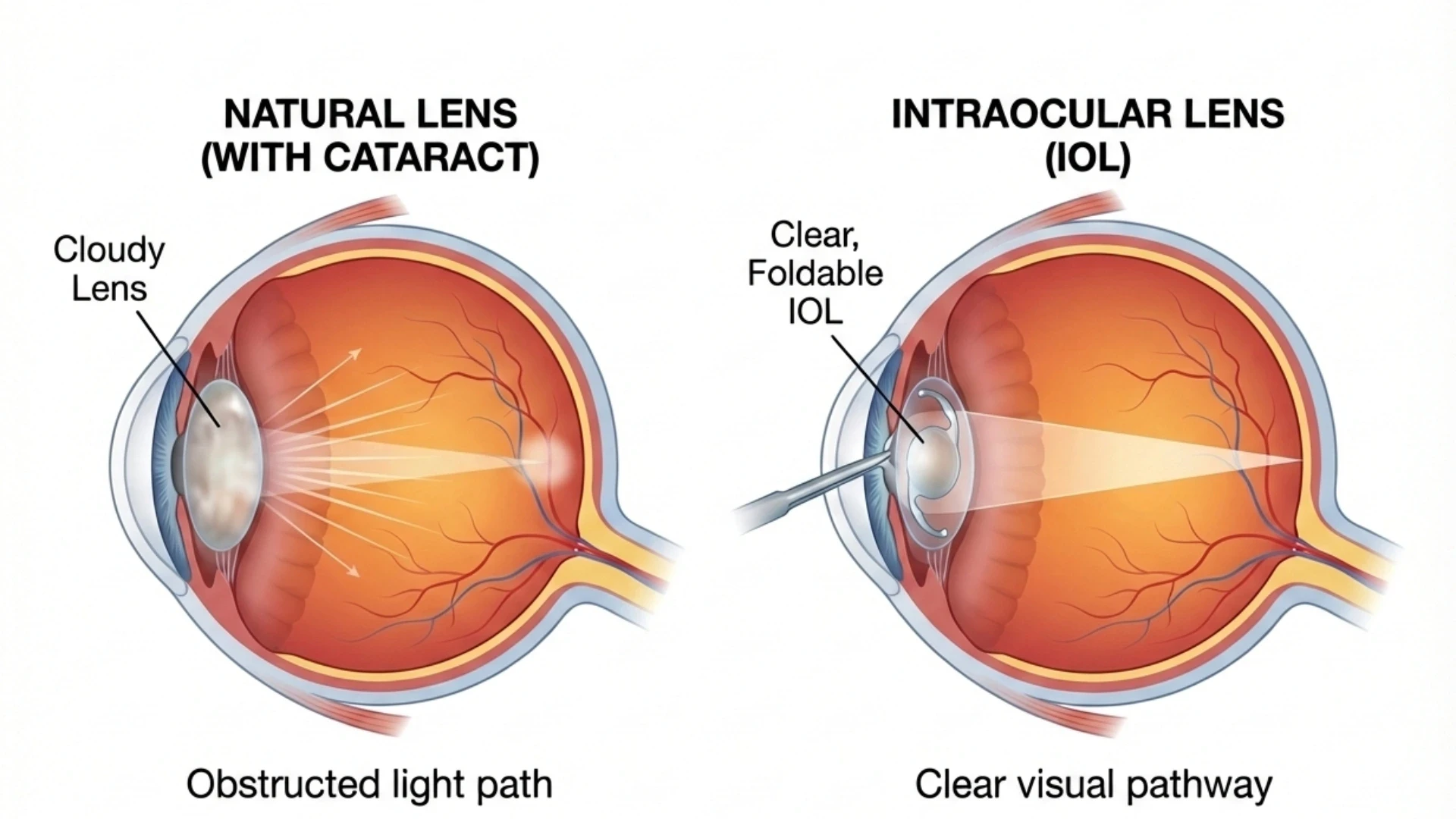
Understanding the basics helps make sense of your options. During cataract surgery, your surgeon removes your clouded natural lens and replaces it with an artificial one called an intraocular lens (IOL). Think of it as a permanent internal contact lens that never needs cleaning or replacing.
This artificial lens determines how well you'll see afterwards. Your natural lens, back when you were younger, could change its shape to focus on things both near and far. That's what you've lost with the cataract. Most artificial lenses can't do this shape-shifting trick. They have a fixed focal point. This is why your lens choice matters so much.
Your Lens Options Explained
Different lenses give you different visual results. Each comes with its own benefits and compromises.
Monofocal Lenses: Great Distance Vision, Readers Needed
These are the most commonly used lenses worldwide. They're designed to give you sharp distance vision for things like driving, watching television, or spotting friends across the street. The quality is excellent with minimal side effects like halos or glare.
The downside? You'll almost certainly need reading glasses. Checking your phone, reading restaurant menus, doing detailed work—none of that works without glasses when you have monofocal lenses. According to the European Society of Cataract and Refractive Surgeons, monofocal lenses remain the default choice when spectacle independence isn't your main priority, precisely because they deliver the clearest vision with the fewest optical compromises.
Some people try "monovision" with monofocal lenses. Your dominant eye gets set for distance, whilst your other eye is set for intermediate range. Research shows this works for about 50% of patients, though your brain needs time to adapt to using each eye differently.
Extended Depth of Focus (EDOF) Lenses: The Compromise Option
EDOF lenses hit a sweet spot for many people. These newer lenses stretch your range of clear vision. You get good distance sight whilst also improving your intermediate vision—computer screens, car dashboards, supermarket shelves.
A 2024 study in the journal Eye found that fully refractive EDOF lenses provided significantly better intermediate and near vision than enhanced monofocal lenses, whilst keeping good visual quality. Most patients manage daily activities without glasses, though you might still grab reading glasses for small print or long reading sessions, particularly in dim light.
The advantage here is fewer bothersome visual disturbances compared to multifocal lenses. Less halo around the lights at night. This makes EDOF lenses particularly good if you drive frequently after dark or you're quite particular about visual quality.
Trifocal and Multifocal Lenses: Maximum Freedom from Glasses
Want to minimise glasses as much as possible? These sophisticated lenses split incoming light to provide clear vision at multiple distances—far, intermediate, and near.
The results can be impressive. A 2023 systematic review found that roughly 90% of patients with modern trifocal IOLs (like the AT Lisa) achieved complete spectacle independence for all distances. That means reading books, using computers, and seeing distant objects clearly without glasses.
But there's a catch. These lenses can cause halos, glare, or starbursts around lights, especially at night. Many patients adapt over several months, but some find these visual effects genuinely annoying. These lenses work best for people with healthy eyes, realistic expectations, and who aren't overly bothered by minor visual oddities.
Toric Lenses: For Astigmatism
If you have astigmatism—where your cornea has an irregular curve causing blurred vision—toric lenses can correct this during your cataract surgery. Toric technology can be combined with any of the lens types above.
Clinical guidelines recommend toric lenses for patients with 1 dioptre or more of corneal astigmatism, with the strongest evidence supporting their use above 2 dioptres. By fixing your astigmatism, toric lenses significantly improve your chances of spectacle-free distance vision. Your near vision still depends on whether the underlying lens is monofocal, EDOF, or multifocal though.
What Else Affects Whether You'll Need Glasses
Beyond which lens you choose, several other factors play a role.
Your Lifestyle Matters
Someone who reads for hours every day has different needs than someone who spends most evenings driving. Your surgeon should discuss your daily activities, hobbies, and what matters most to you visually. There's no universally "best" lens—only the best lens for your particular life.
Your Eye Health
Pre-existing eye conditions affect which lenses suit you. Things like macular disease, advanced glaucoma, significant dry eye, or corneal irregularities all influence the decision. The ESCRS guideline explicitly recommends restricting presbyopia-correcting IOLs to patients with good macular and optic nerve health. If you've got other eye problems, your surgeon might recommend monofocal or EDOF lenses rather than multifocal options to optimise your visual outcome.
Surgical Accuracy and Healing
Even the best lens needs accurate placement and proper healing. Your surgeon takes precise measurements (biometry) before surgery to calculate the correct lens power. Modern calculation methods are remarkably accurate, though small errors can occur. Most patients hit their target vision, but occasionally enhancement procedures (like laser vision correction) might be needed to fine-tune things.
Your Personality
This sounds odd, but research suggests that personality traits influence satisfaction with premium lenses. Patients who are more adaptable and less perfectionistic tend to adjust better to the minor trade-offs of multifocal lenses. Those who are detail-oriented often prefer the pristine quality of monofocal vision, even if it means wearing reading glasses.
Setting Realistic Expectations
No IOL guarantees perfect vision in every situation. All lenses involve compromises between range of focus, visual quality, and optical side effects.
Choose monofocal lenses? Expect to need reading glasses for most close-up tasks. Enhanced monofocal strategies or monovision can reduce this dependency, but won't eliminate it completely.
With EDOF lenses, many patients function through daily life without glasses. You might still need them for fine print, prolonged reading, or low-light situations, though.
Trifocal and multifocal lenses offer the highest spectacle independence. Research confirms that most patients achieve complete freedom from glasses. But you must accept some visual phenomena, particularly halos around lights. Your brain typically adapts over several months.
Even with excellent outcomes, about 5 to 10% of trifocal patients still occasionally want glasses for specific tasks. Reading very fine print for extended periods. Night driving in challenging conditions.
Finding Your Best Option
At International Eye Cataract Retina Centre, we understand that cataract surgery is about more than just removing a cloudy lens. It's about optimising your vision for the life you want to lead.
During your consultation, our experienced ophthalmologists take time to understand your visual needs, lifestyle, and expectations. We'll discuss your lens options thoroughly, explaining the benefits and limitations of each type without medical jargon. Our goal is to help you make an informed decision that aligns with your priorities, whether that's spectacle independence, pristine visual quality, or a balanced approach.
Modern cataract surgery offers remarkable outcomes. Most patients achieve significant improvements in vision and quality of life. With the right lens choice and realistic expectations, you can look forward to clearer, brighter vision, whether that includes glasses or not.
Ready to explore your options? Book a cataract consultation at IECRC to discuss which IOL suits your vision goals and lifestyle.