Understanding Refractive Errors: A Comprehensive Guide to Myopia, Hyperopia, Astigmatism and Presbyopia
Vision is one of the most vital senses through which we perceive the world. For the human eye to see clearly, light rays must travel through the cornea and lens and focus precisely on the retina, the light-sensitive layer at the back of the eye. Think of the eye as a camera: if the lens does not focus the light directly onto the film (the retina), the resulting image is blurred.
When the eye fails to focus light correctly due to the shape of the cornea or the length of the eyeball, the condition is known medically as a Refractive Error. This is not an infection or a disease in the traditional sense, but rather a structural imperfection in the eye's optical system. While many individuals accept blurred vision as a part of life, understanding the specific mechanics of these conditions is crucial for long-term eye health, particularly in Singapore, where the prevalence of vision issues is among the highest in the world.
This guide provides an in-depth look at the various types of refractive errors, their causes, the clinical procedures used to manage them, and lifestyle habits that can help maintain ocular health.
The Anatomy of Vision: How Refractive Errors Occur
To understand why vision becomes blurry, one must first appreciate the mechanism of normal sight. In a perfectly shaped eye (emmetropia), light rays entering the eye are bent (refracted) by the cornea and the lens to land at a sharp focal point directly on the retina. The retina then converts these light rays into neural signals, which are sent via the optic nerve to the brain to be interpreted as images.
A refractive error occurs when this precise calibration is off-balance. This usually happens for one of three reasons:
Axial Length: The eyeball is either too long or too short.
Corneal Curvature: The front surface of the eye is irregular or too steep/flat.
Lens Power: The internal lens has excessive or insufficient focusing power.
According to the National Eye Institute, refractive errors are the most common vision problems worldwide. In Singapore, the statistics are particularly stark, with significant portions of the younger population requiring vision correction by the time they finish primary school.
Types of Refractive Errors
There are four primary types of refractive errors that affect patients of all ages. Each presents with unique symptoms and requires specific management strategies.
1. Myopia (Short-sightedness)
Condition Overview
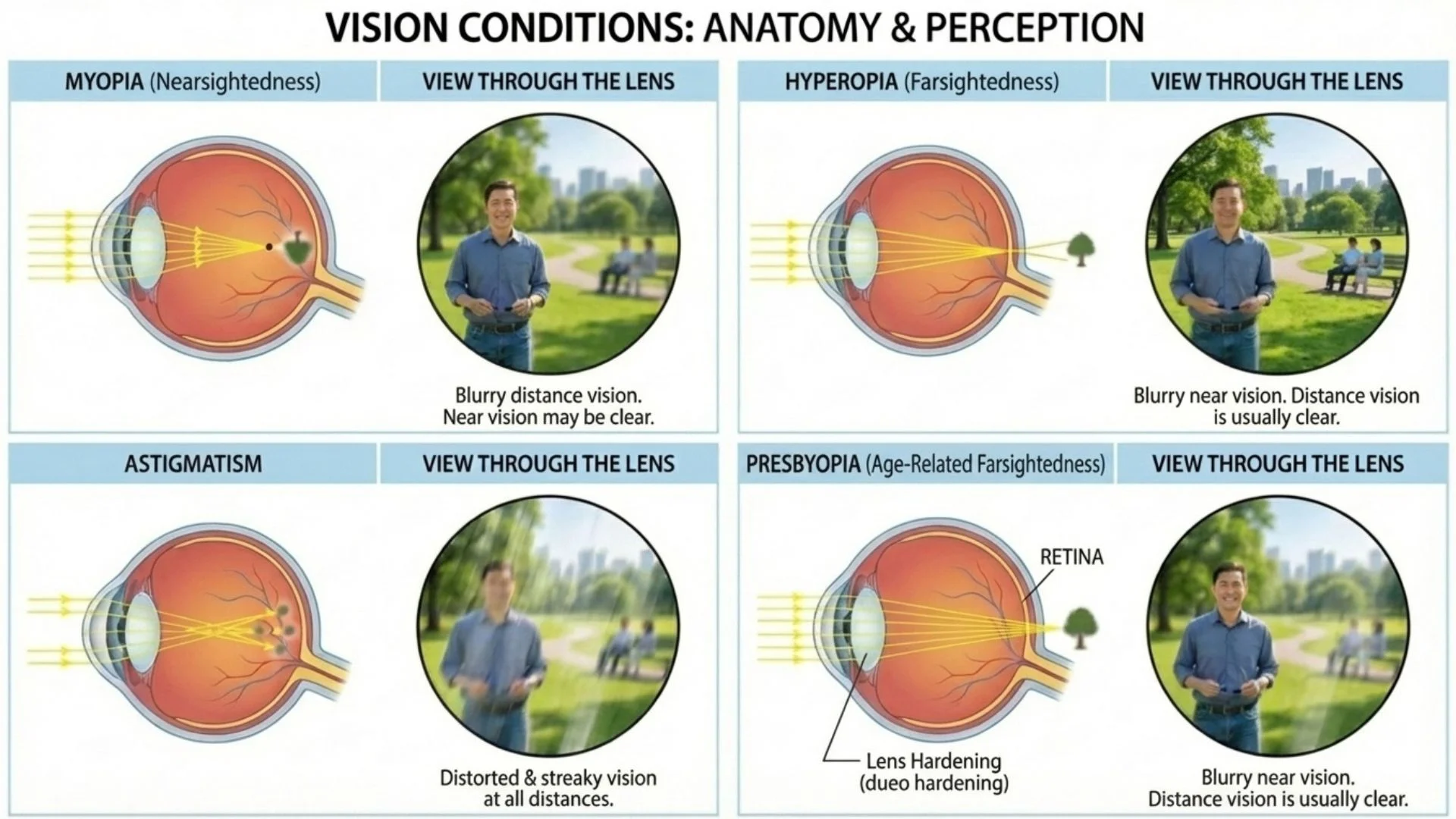
Myopia occurs when the eyeball is too long or the cornea is too curved, causing distant objects to appear blurry whilst near objects remain clear. In Singapore, this represents a significant public health concern, with approximately 10% of Primary 1 students affected, rising to 60% by Primary 6, and nearly 80% by age 18.
High myopia (exceeding -5.00 to -6.00 dioptres) poses serious medical risks including retinal tears, retinal detachment, myopic maculopathy, glaucoma, and early cataract development. Importantly, whilst laser surgery corrects vision, it does not reverse eyeball elongation, meaning high myopia risks persist even after vision correction surgery.
Signs & Symptoms
Difficulty seeing distant objects clearly, squinting to see far away, trouble seeing the board at school or road signs whilst driving.
Diagnosis
Comprehensive eye examination includes visual acuity testing, refraction assessment with a phoropter, and for children, cycloplegic refraction using eye drops to temporarily paralyse focusing muscles for accurate measurements. Optical biometry measures axial length to track progression, providing more accurate prediction of risk than spectacle power alone.
Treatment Options
Non-surgical: Spectacles with concave lenses or contact lenses.
Myopia control for children: Low-dose atropine eye drops (0.01% to 0.05%) can slow progression by 50-60% over two years with minimal side effects. If ineffective, higher concentrations may be prescribed with photochromic glasses or bifocals to manage side effects. Peripheral defocus spectacles and myopia control contact lenses, including orthokeratology (Ortho-K) lenses worn overnight, can slow axial elongation by 30-63%, though Ortho-K carries higher infection risk requiring strict hygiene.
Surgical (adults): Laser refractive surgery (LASIK/SMILE/PRK) to reshape the cornea, or Implantable Collamer Lenses (ICL) for very high degrees or thin corneas. Annual retinal checks remain essential post-surgery.
2. Hyperopia (Long-sightedness)
Condition Overview
Hyperopia occurs when the eyeball is too short or the cornea is too flat, causing light to focus behind the retina. Distance vision may remain relatively better whilst near objects appear blurry.
Some degree is normal in infants and toddlers, as children have strong accommodation that often compensates without glasses. However, severe hyperopia can lead to eye strain, headaches, or crossed eyes (accommodative esotropia) and lazy eye (amblyopia). In adults, as natural focusing ability declines with age, hyperopic individuals may need reading glasses earlier than their peers.
Signs & Symptoms
Blurred near vision, eye strain particularly after close work, aching or burning eyes, difficulty concentrating on near tasks. Children may rub eyes frequently or show disinterest in reading.
Diagnosis
Visual acuity assessment, refraction testing with a phoropter, retinoscopy for young children, and dilating eye drops for accurate measurement by relaxing the lens.
Treatment Options
Optical correction: Spectacles with convex lenses or contact lenses in various designs.
Surgical options: LASIK or PRK to steepen the cornea (suitable for lower amounts), or refractive lens exchange (RLE) for higher amounts. Children with severe hyperopia and accommodative esotropia typically need spectacles; surgical correction generally delayed until adulthood. All surgical options require monitoring to prevent complications.
3. Astigmatism
Condition Overview
Astigmatism features an irregularly shaped cornea or lens (more like a rugby ball than a basketball) causing light to focus on multiple points rather than a single focal point. This creates blurred or distorted vision at all distances.
It often coexists with myopia or hyperopia and can be hereditary, caused by corneal scars and injuries, or worsened by excessive eye rubbing.
Signs & Symptoms
Blurred or distorted vision at all distances, streaky vision or haloes around lights (especially at night), difficulty with night driving.
Diagnosis
Visual acuity testing, refraction assessment, keratometry to measure corneal curvature, corneal topography for detailed mapping. Prescriptions include cylinder (degree of astigmatism) and axis (location on cornea) measurements.
Treatment Options
Optical correction: Spectacles with cylindrical lenses, toric contact lenses specifically designed for astigmatism, or orthokeratology (Ortho-K) rigid lenses for temporary correction.
Surgical options: LASIK to smooth irregular corneal curve, PRK (Photorefractive Keratectomy), or LASEK (Laser-Assisted Subepithelial Keratectomy).
4. Presbyopia ("Lao Hua")
Condition Overview
Presbyopia is a universal age-related condition typically beginning in one's 40s. The eye's natural lens becomes less flexible over time, losing its ability to change shape for near focus.
This progressive condition worsens until around age 65 when changes tend to stabilise. Unlike childhood refractive errors, presbyopia affects everyone as part of natural ageing.
Signs & Symptoms
Difficulty reading small print, needing to hold reading materials at arm's length ("short arms syndrome"), need for brighter lighting when reading.
Diagnosis
Comprehensive eye examination including visual acuity testing at various distances, near point of accommodation measurement, and dilated eye exam to evaluate overall eye health and concurrent conditions.
Treatment Options
Non-surgical: Reading glasses, bifocals or progressive lenses for multiple distances, multifocal contact lenses, or monovision contact lenses (one eye for distance, one for near).
Pharmacological: Pilocarpine eye drops (recently FDA-approved) improve near focus by constricting the pupil, though side effects like headaches may occur, and there's risk of retinal detachment or tears requiring monitoring.
Surgical options: PresbyLASIK for corneal reshaping, refractive lens exchange with multifocal intraocular lenses, or corneal inlay procedures (limited availability).
Diagnosis of Refractive Errors
Early detection is paramount, especially in children who may not realise their vision is abnormal. Comprehensive eye examinations involve several steps:
Visual Acuity Test
This is the standard "eye chart" test (Snellen chart) placed at a distance (usually 6 metres). It measures how well the patient can distinguish letters or shapes of diminishing sizes.
Refraction Assessment
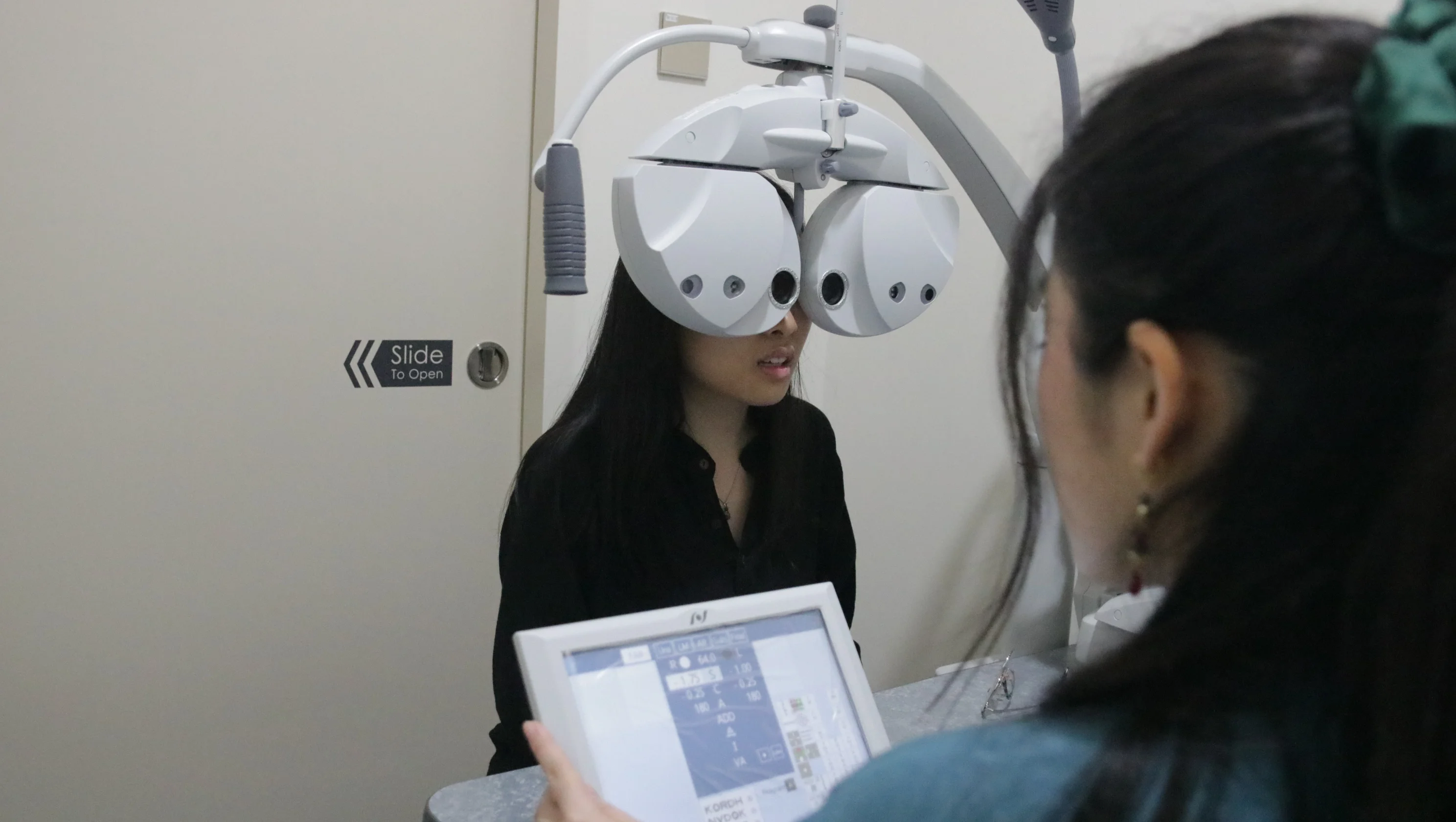
An optometrist or ophthalmologist uses a phoropter (an instrument with various lenses) to determine the exact lens power required to focus light onto the retina.
Cycloplegic Refraction (For Children)
Children have very active focusing muscles that can mask their true refractive error (often hiding hyperopia or making myopia appear worse than it is). To get an accurate reading, doctors often use cycloplegic eye drops.
Function: These drops temporarily paralyse the focusing muscle and dilate the pupil.
Side Effects: The child will experience blurred near vision and light sensitivity for up to 24 hours. This is a standard and safe diagnostic procedure to ensure the prescription prescribed is accurate.
Optical Biometry
To monitor myopia progression, doctors may measure the axial length of the eye using non-invasive laser biometry. Tracking the physical growth of the eyeball (in millimetres) is often a more accurate predictor of progression risk than just tracking the change in spectacle power.
Procedures and Management of Eye Conditions
While refractive errors cannot be "cured" in the sense of a viral infection, they can be effectively corrected and managed. For progressive conditions like childhood myopia, specific medical interventions are available to slow the rate of deterioration.
1. Optical Correction (Non-Surgical)
Spectacles: The most common and safest form of correction.
Concave lenses (minus power) are used for myopia to diverge light rays before they enter the eye.
Convex lenses (plus power) are used for hyperopia to converge light.
Cylindrical lenses are used to correct the irregular curvature of astigmatism.
Contact Lenses: Contact lenses sit directly on the cornea, providing a wider field of view. They are available for myopia, hyperopia, and astigmatism.
Note on Hygiene: Improper handling of contact lenses significantly increases the risk of corneal infections (keratitis), which can lead to permanent scarring and vision loss. They are generally recommended for older children or adults who can demonstrate responsible hygiene compliance.
2. Myopia Control Therapies (For Children)
In Singapore, "Myopia Control" is a specialized area of practice aimed at slowing down the elongation of the eyeball in children. These therapies do not reverse existing myopia but aim to keep the final prescription low to reduce the risk of future pathology.
Atropine Eye Drops: Pharmacological intervention using Atropine is an evidence-based treatment.
Low-Dose (0.01%): Studies suggest this concentration can slow myopia progression by roughly 50-60% over a two-year period with minimal side effects (less glare or near blur).
Higher Doses: If low-dose atropine is ineffective, ophthalmologists may increase the concentration (e.g., 0.1% or 0.5%). This typically requires the child to wear photochromic glasses or bifocals to manage the side effect of pupil dilation and loss of accommodation.
Consultation: This treatment requires a prescription and regular monitoring by an eye specialist.
Optical Myopia Control:
Peripheral Defocus Spectacles: These are specialized glasses with multiple "lenslets" that focus light differently in the peripheral retina, creating a signal that tells the eye to stop growing.
Myopia Control Contact Lenses: Soft multifocal lenses or Orthokeratology (Ortho-K) lenses worn overnight to reshape the cornea. Research has demonstrated that Ortho-K can slow axial length elongation by 30-63%, though it carries a higher risk of infection and requires strict hygiene.
3. Surgical Vision Correction (For Adults)
Once the eye has stopped growing and the refractive error has stabilized (typically after age 21), surgical options may be considered to achieve spectacle independence.
Laser Refractive Surgery (LASIK / SMILE / PRK): These procedures use lasers to permanently reshape the cornea, altering how light enters the eye.
Myopia: The cornea is flattened.
Hyperopia: The cornea is steepened.
Astigmatism: The irregular curve is smoothed out.
Implantable Collamer Lenses (ICL): For patients with very high degrees of refractive error or thin corneas who are not suitable for laser surgery, an artificial lens can be surgically implanted inside the eye behind the iris.
Risks and Limitations of Surgery: It is a regulatory requirement to understand that no surgery is risk-free. Risks include:
Dry eye syndrome.
Glare, haloes, and starbursts (especially at night).
Under-correction or over-correction (requiring enhancement).
Infection or flap complications.
In rare cases, permanent reduction in best-corrected visual acuity.
Important: Refractive surgery corrects the focus but does not cure the underlying elongated shape of the eye in high myopes. Therefore, annual retinal checks are still required to screen for tears or detachment.
To explore if these procedures are relevant to your condition, you may wish to speak with our doctors.
Remedies and Lifestyle Prevention
While genetics cannot be changed, lifestyle modifications play a critical role in the management of refractive errors, particularly in preventing the onset and rapid progression of myopia in children.
The "Outdoor" Effect
Multiple international studies indicate that spending time outdoors is protective against myopia. The Health Promotion Board (HPB) and eye care professionals recommend that children spend at least 2 hours per day outdoors in natural daylight.
Mechanism: The intensity of outdoor light (even on a cloudy day) is significantly higher than indoor lighting. This triggers the release of retinal dopamine, which inhibits axial elongation.
Application: Encourage outdoor play, walking to school, or outdoor sports.
Visual Hygiene & The 20-20-20 Rule
Excessive near work (reading, gaming, homework) causes eye strain and may drive myopia progression. The 20-20-20 rule is a standard recommendation:
Every 20 minutes of near work,
Look at something 20 feet (6 metres) away,
For at least 20 seconds.
This relaxes the ciliary muscles (focusing muscles) inside the eye, reducing fatigue.
Lighting and posture
Ensure reading material is held at a standardized distance (approx. 30-40cm), not too close to the face.
"Elbow distance" is a good gauge: the distance from the eye to the book should be roughly the distance from the hand to the elbow.
Ensure the room is well-lit to reduce the strain of contrast.
Diet and Nutrition
While no specific food "cures" refractive errors, a balanced diet supports overall eye health. Nutrients such as Vitamin A, Vitamin C, Vitamin E, Lutein, and Zeaxanthin support the retina and overall ocular integrity. However, relying solely on supplements without optical or pharmacological intervention is not a medically proven method for controlling myopia progression.
Regular Eye Examinations
Refractive errors can change rapidly, especially during puberty.
Children: Should undergo vision screening annually. If myopic, checks may be needed every 4 to 6 months to monitor progression and adjust treatment (e.g., Atropine dosage).
Adults: Annual screening is recommended to check for prescription changes and screen for associated risks like glaucoma or retinal tears, which are silent in early stages.
For families concerned about their child's vision, obtaining a formal diagnosis is the first step. You can arrange a comprehensive assessment through our appointment system.
Conclusion
Refractive errors like myopia, hyperopia, and astigmatism are more than just inconveniences requiring glasses; they are complex physiological conditions that interact with our genetics and environment. With the rising prevalence of myopia in Singapore, shifting the mindset from "correction" to "management and control" is vital.
By combining appropriate medical interventions such as Atropine drops or specialized optics with positive lifestyle changes like increased outdoor time and better visual ergonomics, we can effectively manage these conditions. The goal is not just clear vision for today, but healthy eyes for a lifetime.
Important Medical Notice: This information provides general educational content about refractive errors and should not replace professional medical advice. For personalized assessment and treatment recommendations, please schedule a consultation with our eye care specialists. All vision correction methods including spectacles, contact lenses, and surgical procedures carry risks and limitations. Contact lenses carry risks of infection and corneal complications. Surgical corrections carry risks including infection, vision loss, need for additional procedures, and in rare cases permanent blindness. All options should be thoroughly discussed with a qualified ophthalmologist.
Licensed Healthcare Service: Our clinic operates in accordance with healthcare regulations. For questions about our services or to book an appointment, please visit our contact page or call during operating hours. For medical emergencies, contact emergency services immediately.
When to Seek Professional Care
Blurred vision occurs when light fails to focus correctly on the retina due to the eye's shape or optical structure. Please visit the doctor if you have any of the following symptoms:
Difficulty seeing distant objects clearly (squinting required)
Blurred vision when reading or close work
Frequent headaches after visual tasks or studying
Distorted or streaky lights, especially at night
Holding reading materials unusually far or close
Early detection through comprehensive eye examinations ensures timely intervention, preventing progression and protecting long-term ocular health for all ages.